 DesignFlux Team
Design subscriptions promise unlimited graphic design for one flat monthly fee. But is a design subscription worth it? For some teams that’s the best money they spend all month. For others it’s an expensive habit they forget to cancel.
The difference usually isn’t the service itself. It’s how much design you need, how often, and what you’re doing about it today.
A marketing team producing new advertising creatives every week has very different needs from a small business that only requires an occasional flyer.
Likewise, an agency managing several client brands may benefit from consistent design support, while a startup with a limited workload might prefer a freelancer.
Here’s a straightforward way to work out which side of the line you’re on.
What you actually get
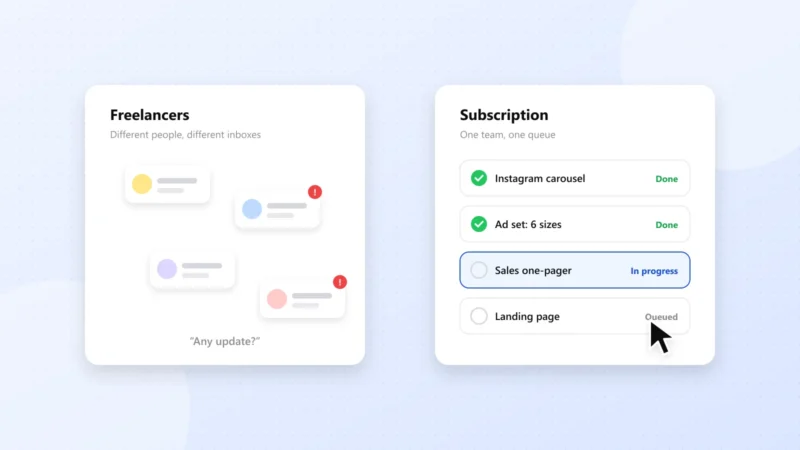
A design subscription replaces hiring, freelancers or agency projects with one recurring fee. You submit requests, the team works through them in your order of priority, and you revise each one as many times as you need.
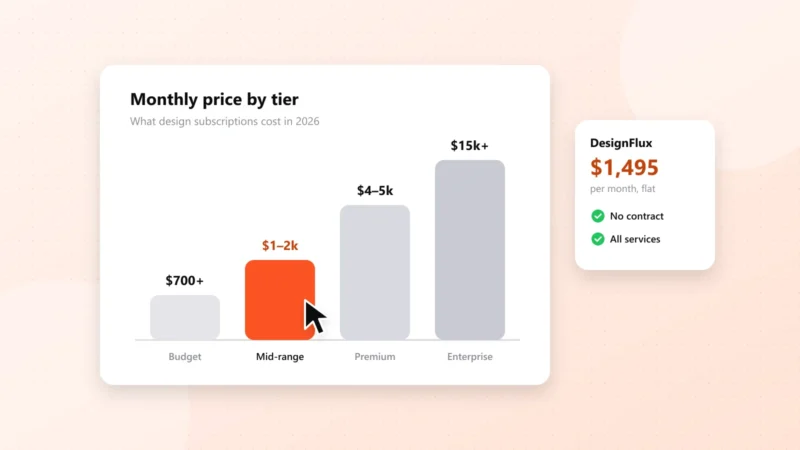
At DesignFlux, for example, $1,495 a month covers:
- Unlimited requests and unlimited revisions
- A dedicated designer and a project manager, in Slack
- Most designs delivered in 24-48 hours
- Every type of covered graphic design: logos, social, ads, decks, landing pages and print
- Unlimited brands and team members, with no contract
The main benefit is having a predictable design budget without negotiating a separate price for every graphic, presentation or advertising campaign.
However, unlimited requests don’t mean unlimited simultaneous production.
Most subscription services complete one or several requests at a time, depending on the plan. Your actual monthly output depends on project complexity, revision requirements and available production capacity.
For example, a simple promotional banner may return much faster than a detailed brand identity or multi-page presentation.
Prices across the market range from about $700 to $5,000 a month for many standard and premium services, although some budget providers charge less and enterprise services cost considerably more.
We break those prices down in our guide to how much a graphic design subscription costs.
Is a design subscription worth it? The five-question test
Answer these honestly. The more “yes” answers, the more likely a subscription will pay off.
1. Do you need design every week?
This is the big one. A subscription earns its keep through volume and consistency: social posts every week, new ads every campaign, and a steady stream of sales collateral.
If you need one logo this year and nothing else, it’s not for you.
However, if your team regularly produces marketing materials, a recurring design service can simplify the process.
For example, an ecommerce business might need product promotions, seasonal banners, advertising variations and email graphics every month.
Rather than finding a freelancer for each project, the business can maintain one ongoing design workflow.
The more frequently you need new creative assets, the more useful that arrangement becomes.
Start by reviewing your last 30 days of design work. Count both completed projects and requests you postponed because nobody had time to handle them.
That gives you a more realistic picture of your recurring needs.
2. Are you paying (or losing) more than $1,500 a month on design today?
Add up what design really costs you now: freelancer invoices, agency fees, software, and the hours your team spends designing in Canva or chasing designers.
Many teams underestimate their total design expenses because those costs appear in different places.
For example, imagine paying a freelancer $800 per month while an employee spends another 12 hours preparing graphics and coordinating revisions.
The actual cost includes both the external invoice and the value of your employee’s time.
You should also consider delayed work, missed campaign deadlines and additional payments for urgent requests.
However, don’t count expenses that a subscription wouldn’t replace. If your team still needs specialized software or internal design work, those costs may remain.
The goal is to compare avoidable expenses against the subscription fee.
3. Is design slowing anything down?
Launches waiting on visuals, ads not getting tested because no one has time to make variations, a sales deck that’s two years old.
Delays have a cost even when nobody sends an invoice for them.
For example, a marketing team may have several advertising ideas but only enough design capacity to create one version.
That limits how many creative approaches the team can test.
Similarly, outdated presentations and inconsistent website visuals can slow down sales and marketing activities.
A subscription can help by providing ongoing access to design production.
However, faster design work doesn’t automatically guarantee higher sales or better advertising results.
The benefit is removing a production bottleneck so your team can execute planned activities more consistently.
4. Do you manage more than one brand or client?
Agencies, multi-brand businesses and consultants often get significant value from design subscriptions.
One subscription can cover several brands when the provider’s plan allows it, and at DesignFlux, white-label work for agencies is included.
For example, a small marketing agency might manage social media and advertising creatives for five clients.
Each client needs different fonts, colors, logos and campaign messaging.
Using separate freelancers can create additional coordination work, especially when projects overlap.
A subscription with dedicated creative support can simplify that process.
However, check whether multiple brands, users and white-label delivery are included in the plan or require additional fees.
Also, confirm how the provider handles simultaneous requests across different clients.
5. Are you comfortable briefing clearly?
Subscriptions work best when you can say what you want.
You don’t need to be a designer, but you need to share goals, examples and copy. Our guide to writing a design brief helps.
For example, “Create a promotional Instagram post” gives your designer very little direction.
A stronger request includes the product, offer, target audience, dimensions, approved copy and visual references.
That information reduces unnecessary questions and helps the designer understand your expectations.
You should also provide brand guidelines, original logos and approved images whenever possible.
Clear communication doesn’t eliminate every revision, but it gives the project a better starting point.
If your team struggles to prepare briefs or approve designs, improving that internal process should be part of your subscription decision.
The break-even math: is a design subscription worth it financially?
Here’s the quickest way to sanity-check the price. Compare a $1,495 subscription with what you’d otherwise pay:
| Alternative | Typical cost | Break-even point |
|---|---|---|
| Freelancer at $40/hour | Hourly | About 37 hours of design a month (roughly 9 hours a week) |
| Freelancer at $75/hour | Hourly | About 20 hours a month (5 hours a week) |
| Agency at $150/hour | Hourly | About 10 hours a month |
| In-house designer | About $5,247/month median wage, before benefits and software | Subscription costs less from month one, but capacity and responsibilities differ |
The in-house figure comes from the U.S. Bureau of Labor Statistics, which reports that the median annual wage for graphic designers was $62,960 in May 2025, approximately $5,247 per month.
Benefits, payroll taxes and software may add another 20-30% or more, depending on the employer.
For example, using a 25% allowance for employer benefits and payroll-related expenses brings that illustrative monthly compensation cost to approximately $6,558, before equipment and other overhead.
Understanding the break-even point
At $75 per hour, 20 hours of freelance design costs $1,500.
That’s approximately the same as DesignFlux’s $1,495 monthly subscription.
Similarly, ten hours at an agency rate of $150 per hour costs $1,500.
If your design needs are near those break-even points, a subscription may cost less than purchasing the equivalent amount of freelance or agency time.
It can also reduce the time your team spends finding designers, coordinating deadlines and managing invoices.
However, these calculations compare spending, not guaranteed production capacity.
A subscription does not promise the same number of dedicated hours as a freelancer or full-time employee.
Before switching, check whether the service can realistically complete your usual workload within your required deadlines.
What if your workload changes every month?
A subscription offers the most value when you use it consistently.
For example, a company might submit 15 requests during a busy promotional month but only two during a quieter period.
The monthly fee usually remains the same.
Therefore, calculate your average design needs over several months rather than basing the decision on one unusually busy week.
If your workload fluctuates significantly, check whether the provider offers cancellation or pausing options.
When a design subscription is worth it
A subscription is particularly useful for:
- Marketing teams that publish every week and want ads, social content and email graphics designed quickly
- Startups that need pitch decks, landing pages and brand assets without hiring a full-time designer
- Agencies that want extra design capacity under their own brand
- Ecommerce brands with constant product launches, promotions and seasonal campaigns
- Teams that tried freelancers and got tired of re-briefing new people
These businesses share one important characteristic: design is an ongoing operational requirement rather than an occasional project.
For example, an ecommerce brand might regularly need product advertisements, promotional banners, seasonal sale graphics and website updates.
A marketing agency may need similar assets for several client accounts.
Instead of repeatedly requesting quotes and negotiating deadlines, both businesses can submit work through an established subscription process.
However, the subscription still needs to match the required volume and service scope.
Is a design subscription worth it when your team has a steady stream of marketing deliverables? It often can be, particularly when recurring freelancer expenses and management time approach the subscription fee.
When it isn’t
You need one or two designs a year. Hire a freelancer for the project.
Paying a recurring subscription for occasional work is rarely economical.
You need design embedded in product decisions every day. Hire in-house.
A dedicated employee can participate continuously in product planning, internal discussions and development decisions.
You need video, 3D or animation as your main deliverable. Look for a specialist.
Some subscription providers offer these capabilities, but not every graphic design plan includes them.
You won’t have time to send requests. A subscription only pays off if you use it.
For example, a business owner who subscribes without preparing any briefs may end up paying for unused production capacity.
Before subscribing, make sure someone on your team can submit work, provide feedback and approve completed designs.
A subscription simplifies design production, but it doesn’t replace the need for clear direction.
How to test it without risk
The good news is you don’t have to guess. Many services have a trial or refund window, so use it properly:
- Prepare a backlog before you start. List 10-15 real requests you need this month.
- Send the hardest request first. Judge the quality on real work, not a simple resize.
- Track turnaround and revisions. How fast did work come back? How many rounds did it take?
- Decide within the refund window. At DesignFlux, your first design is covered by a refund promise if you’re unhappy, and the service advertises 75% back if you cancel within the first week.
For example, submit a project that represents the type of work you’ll request regularly.
That could be a promotional advertising creative, a multi-slide social media carousel or a branded presentation.
Evaluate whether the designer follows your instructions, uses your brand assets correctly and responds constructively to feedback.
Also, test the communication workflow.
Can you submit new requests easily? Is it clear which project is currently active? Does the project manager help keep work organized?
These details matter just as much as the finished design.
Measure the results before committing
During your first subscription period, track three things: quality, turnaround and completed output.
Quality tells you whether the provider understands your brand and meets your expectations.
Turnaround helps you determine whether the workflow supports your deadlines.
Completed output shows how much useful design work the subscription actually produces.
Also, review cancellation and refund conditions before purchasing. A limited refund window is not the same as a completely risk-free trial.
If the service delivers consistently and the production capacity suits your workload, continuing becomes an easier decision.
The bottom line: is a design subscription worth it?
A design subscription is worth it when you have steady design needs and you’re already spending, in money or time, more than the subscription costs.
If that describes your business, switching to a subscription may reduce expenses and make ongoing creative production easier to manage.
If not, a freelancer for the occasional project is usually the smarter buy.
However, financial savings shouldn’t be your only consideration.
The right provider should understand your brand, deliver usable designs and support your deadlines.
For businesses producing regular social media content, advertisements, presentations and website graphics, predictable creative support can remove a significant operational bottleneck.
DesignFlux offers unlimited eligible design requests and revisions for $1,495 per month, with a dedicated designer, project manager and direct Slack communication.
Ultimately, is a design subscription worth it for your business? Look at your monthly workload, current spending and production delays. If the service can handle your recurring requests at a lower overall cost, the numbers may justify the subscription.
Still weighing it up? Compare the options in design subscription vs. freelancer, or see what’s included in DesignFlux.