 DesignFlux Team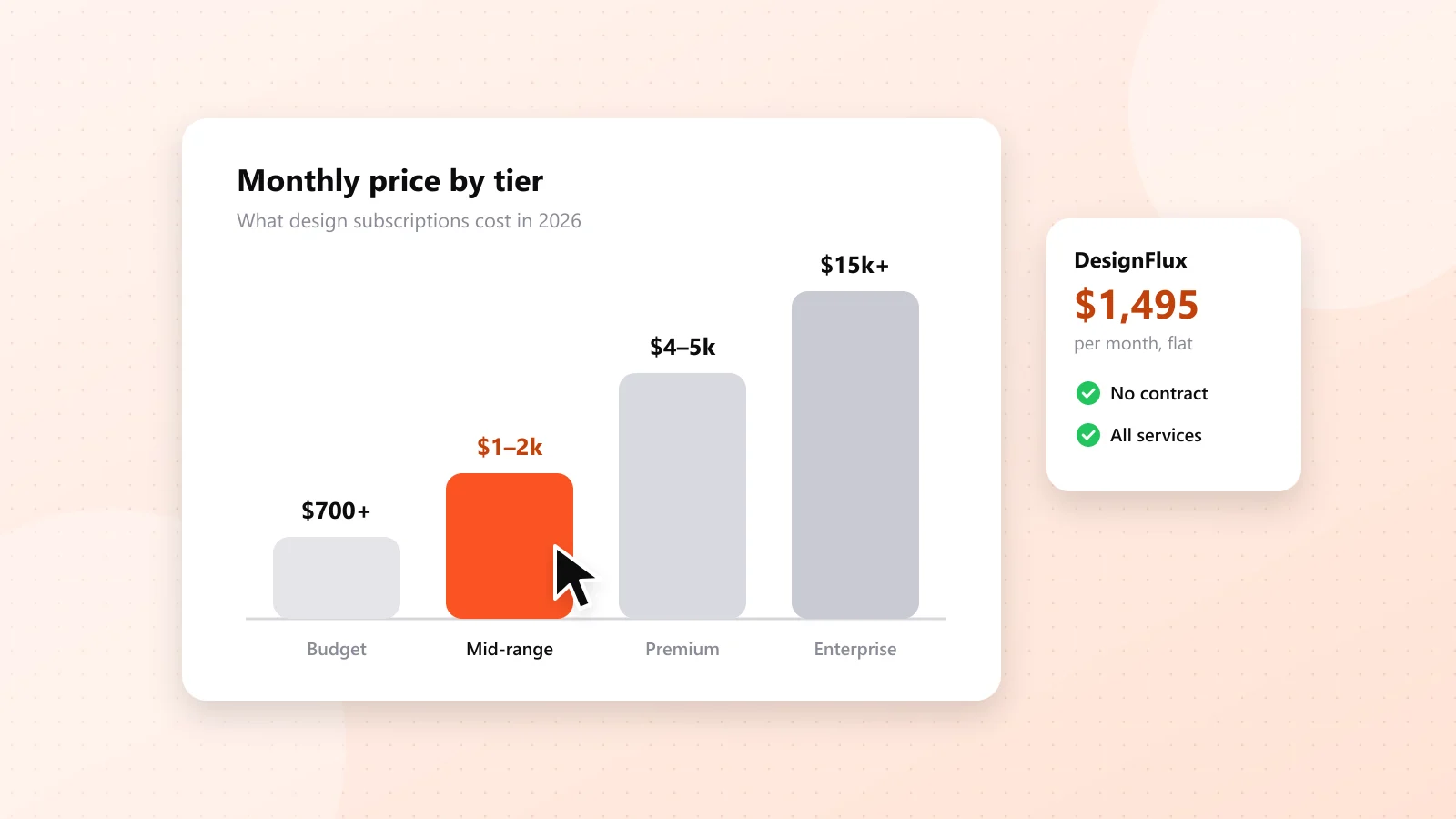
Short answer: most graphic design subscriptions cost between $700 and $2,000 a month. However, graphic design subscription cost varies considerably depending on the provider, the number of active requests and the services included. Budget plans can start around $649, premium boutique services charge around $5,000, and enterprise creative partners start at $15,000 or more.
That’s a wide range for something usually described the same way: unlimited graphic design for a flat monthly fee. The price differences come down to a few things you can check on any pricing page. Here’s how it breaks down.
For example, a startup needing several social media graphics each week won’t have the same requirements as an agency managing multiple client brands. An enterprise marketing department producing large campaigns needs something else entirely.
Understanding what each pricing tier includes helps you avoid two mistakes: paying for capacity you don’t need, or choosing a plan that cannot keep up with your workload.
All prices below were checked against publicly available provider information on October 17, 2026. Plans change often, so always confirm before you subscribe.
Graphic design subscription cost: price tiers at a glance
| Tier | Typical monthly price | What you usually get | Examples |
|---|---|---|---|
| Budget | $649–$1,000 | One request or limited designer hours per day, with shared or assigned designer support | ManyPixels ($699), Delesign ($649), Penji Essentials ($995) |
| Mid-range | $1,000–$2,000 | A dedicated designer, often a project manager, and more requests or production hours | DesignFlux ($1,495), Flocksy ($1,199+, billed annually), Kimp (about $1,397) |
| Premium | $4,000–$5,000 | Boutique, senior-led service or a larger dedicated creative team | Designjoy ($4,995), Penji Dedicated Team ($4,500) |
| Enterprise | $15,000+ | Strategy, production, video and dedicated creative support on annual terms | Superside ($15,000 monthly minimum) |
These categories are useful starting points rather than strict industry standards. Some lower-priced services provide dedicated designers, while more expensive plans may focus on additional workstreams or specialized creative capabilities.
For a deeper look at each provider, read our comparison of the best unlimited graphic design services.
What each pricing tier means in practice
Budget subscriptions are often suitable for startups and small businesses with straightforward recurring design needs.
For example, a business might need social media posts, promotional graphics, basic presentations and occasional print materials. A lower-cost subscription may provide enough capacity without a larger monthly commitment.
Mid-range subscriptions typically serve growing marketing teams, ecommerce businesses and agencies that regularly need several types of creative assets.
At this level, dedicated design support and consistent project management can become more important than finding the lowest price.
Premium subscriptions may provide a specific senior designer’s expertise, more production capacity or a broader creative team.
Meanwhile, enterprise services often combine graphic design with campaign strategy, video, creative direction and additional marketing capabilities.
The right tier depends on your actual design workload rather than company size alone.
What drives graphic design subscription cost?
Five factors explain most differences between subscription plans.
1. How much work moves at once
“Unlimited” almost always means an unlimited queue. The real output depends on how many requests are in progress at the same time, or how many designer hours per day you get.
A plan with two active requests may offer more production capacity than one with a single active request. It won’t necessarily produce twice as much work, though. Project complexity and available designer time also matter.
For example, a simple promotional banner might require significantly less time than a multi-page presentation or detailed brand identity.
Therefore, ask how providers define an active request and whether larger projects count as multiple tasks.
The number of completed deliverables matters more than the number of requests you can submit.
2. Who you work with
The cheapest plans sometimes route your work to whichever designer is available. Other budget services, including Delesign, offer dedicated designer support.
Mid-range plans frequently provide a dedicated designer who learns your brand, and many add a project manager to keep things moving.
That continuity can make work faster and more consistent over time.
For example, a designer who already understands your colors, typography and preferred layouts needs less explanation when preparing new advertising creatives.
However, don’t assume a higher subscription price automatically guarantees a better designer.
Review portfolios, sample work, communication methods and the provider’s process for maintaining quality.
3. Turnaround speed
Next-day and same-day turnaround can cost more than delivery over several days.
Check how each service defines turnaround: first draft or finished design, and business days or calendar days.
For example, a provider advertising 24-hour delivery might mean the first draft of a straightforward social media graphic.
A complete landing page design or detailed illustration could require considerably longer.
Also, check how revisions affect your delivery schedule.
A service with a predictable workflow may offer better practical value than one advertising an aggressive turnaround that rarely applies to complex projects.
4. What’s included
Some plans cover only static graphics. Others include landing pages, presentations, motion, video or web development.
Watch for features locked to higher tiers. For example, some services include Slack communication or white-label delivery only on their more expensive plans.
Editable source files, stock photography, additional team members and multiple brands can also affect the overall value.
If your business regularly produces both advertising graphics and website assets, choosing a plan that covers both may simplify your workflow.
However, don’t pay extra for specialist capabilities your business rarely uses.
Compare included services against the work your team actually needs every month.
5. Billing terms
Many advertised prices assume quarterly or annual billing. The month-to-month price can be 10–25% higher, depending on the provider.
Enterprise services typically require longer commitments, often around 12 months.
For example, a plan advertised at $1,199 per month with annual billing may require a much larger financial commitment than a genuinely month-to-month service.
Always check whether the price displayed is the amount billed monthly or simply the monthly equivalent of a longer subscription.
Additionally, review cancellation deadlines, renewal conditions and refund policies.
These terms can have a significant impact on your actual graphic design subscription cost.
Hidden graphic design subscription costs to check before you subscribe
The monthly price doesn’t always tell the whole story. Before choosing a provider, check for:
- Annual commitments disguised as monthly prices: a lower advertised monthly equivalent may require upfront or annual billing.
- Pause fees: sometimes around $10–$20 a month to preserve an account or unused subscription days.
- Add-ons: extra charges for additional brands, users, source files or rush delivery.
- Stock photos and fonts: some subscriptions exclude premium assets or require separate licenses.
- Refund terms: some offer 75% back in the first week, others provide 14- or 30-day guarantees, and some offer no refund.
- Your own time: a cheap plan that requires constant follow-up may create additional management costs.
For example, a business might choose the least expensive provider but spend several hours each week clarifying briefs, following up on deadlines and correcting inconsistent designs.
That administrative work reduces the value of the cheaper subscription.
Similarly, a low-cost plan may become more expensive if your business regularly needs services available only through paid upgrades.
At DesignFlux, the $1,495 price includes every service within its advertised design scope, unlimited brands, team members, free stock photos and white-label work. There’s no setup fee and no contract.
The goal is to compare the full cost of getting your designs completed, not simply the number printed on the pricing page.
How graphic design subscription cost compares with other options
A design subscription is only one way to manage your creative workload.
Businesses can also hire an in-house designer, retain an agency or work with freelancers.
| Option | Typical cost |
|---|---|
| In-house graphic designer | Median annual wage of $62,960 in May 2025, approximately $5,247/month, plus employer benefits, taxes and software |
| Design agency | Around $150–$300 an hour for many specialized agencies |
| Freelancer | About $25–$150 an hour, depending on experience |
| Design subscription | Around $700–$2,000/month for many standard plans |
According to the U.S. Bureau of Labor Statistics, the median annual wage for graphic designers was $62,960 in May 2025, equivalent to approximately $5,247 per month.
That’s salary alone. Employers also need to account for benefits, payroll taxes, equipment, software and hiring expenses.
For an illustrative budget, adding 20–30% for benefits and payroll-related costs would bring a $5,247 monthly salary to approximately $6,296–$6,821, before other expenses.
However, these options don’t offer identical services.
An in-house designer provides dedicated working hours and close collaboration, while a subscription processes requests within the provider’s production capacity.
Likewise, an agency might offer extensive strategic consulting that a production-focused design subscription doesn’t include.
If you’re weighing a subscription against hiring freelancers, our post on design subscription vs. freelancer runs the break-even math.
An annual cost example
Consider a growing business comparing a full-time designer with a DesignFlux subscription.
| Expense | Estimated annual cost |
|---|---|
| In-house median salary | $62,960 |
| In-house compensation with 25% added | $78,700 |
| DesignFlux at $1,495/month | $17,940 |
| Difference in annual spending | $60,760 |
This example illustrates the difference in direct annual expenses. It does not assume that a subscription provides the same dedicated working hours, strategic involvement or production capacity as an employee.
For a business with regular but manageable design requests, a subscription could offer substantial savings.
However, if design is central to your product and requires daily collaboration, hiring internally might provide better long-term value.
How to compare graphic design subscription plans fairly
Turn every plan into the same three numbers:
- Monthly cost: the actual price on the billing term you’ll choose.
- Production capacity: requests in progress or dedicated designer hours per day.
- Typical turnaround: the expected timeline for your most common request.
Then ask the questions that pricing pages don’t answer: Will I work with the same designer every time? How do we communicate? What happens if I’m not happy in the first week?
Also, check how providers handle multiple brands, complex requests, source files and revisions.
Compare cost against your actual workload
Before subscribing, review your previous month of design requests.
For example, your marketing team might have needed eight social media graphics, four advertising variations, two presentation updates and three website banners.
Use that list to assess whether a provider’s workflow can reasonably support your expected volume.
Then prioritize the deliverables that matter most.
A service with one active request might still be suitable if your deadlines are flexible. However, several urgent campaigns may require a provider with multiple workstreams.
Don’t assume the subscription with the most features is automatically the best value.
A simpler plan that consistently delivers the work you need may be a better investment.
The bottom line
Expect to pay around $700–$2,000 a month for a solid graphic design subscription, although budget options now start as low as $649.
Pay less and you may receive fewer daily production hours or a narrower service offering. Pay more and you’re often buying additional capacity, senior creative expertise or enterprise-level services.
However, a higher price doesn’t automatically guarantee better results.
When evaluating graphic design subscription cost, consider production capacity and turnaround times. Also weigh the quality of previous work and how much management your team needs to provide.
DesignFlux sits in the middle at $1,495 a month, with a dedicated designer and project manager in Slack, unlimited brands and no contract.
For businesses that regularly need social media graphics, advertisements, presentations and other creative assets, a predictable monthly design budget can make planning easier.
Ultimately, the right plan is the one that reliably supports your workload without unnecessary expense.
See exactly what’s included, or read is a design subscription worth it? to check whether it fits your workload.