 DesignFlux Team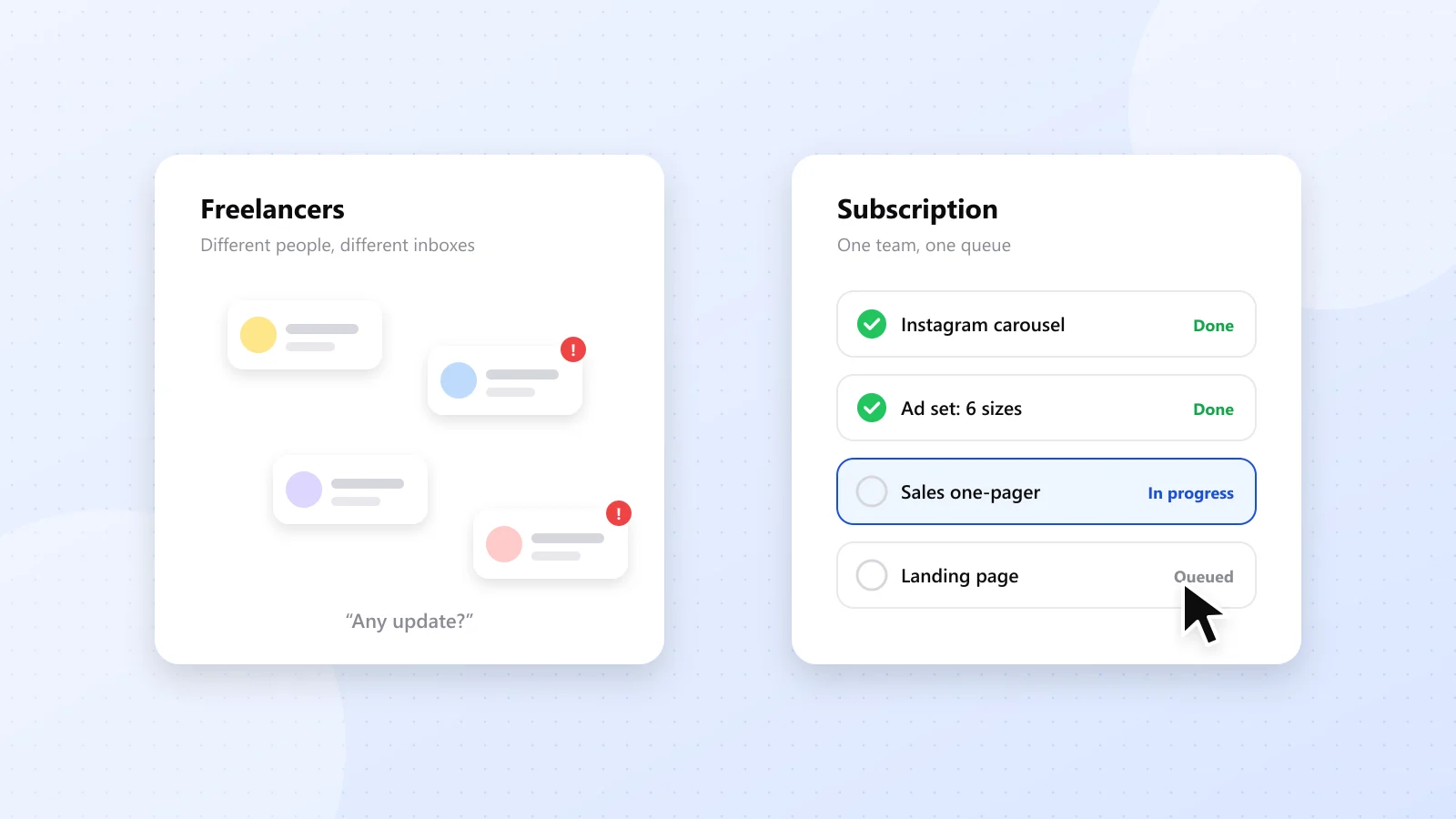
If you need graphic design but don’t want to hire, you’ll usually end up choosing between two options: a freelancer or a design subscription. This design subscription vs freelancer guide compares both options on cost, speed, quality, management time and risk, so you can pick the right one for how your business actually works.
For example, a business needing a single logo has different requirements from a marketing team producing new advertisements, social media graphics and presentations every week.
The right decision depends on your workload, budget and how much time you’re willing to spend managing creative projects.
The quick answer: design subscription vs freelancer
Choose a freelancer for occasional, one-off projects, or for a specialist skill like illustration or 3D.
Choose a design subscription when you need design every week across marketing, sales and social, and you want one predictable cost.
Freelancers offer flexibility because you can hire someone for a specific project without committing to a recurring monthly expense.
A design subscription works differently. You pay a fixed fee and submit design requests through an ongoing production workflow.
This can simplify project management when your business regularly needs new creative assets.
However, subscriptions still have production limits. Unlimited requests usually means you can maintain an unlimited queue, not receive unlimited completed designs simultaneously.
Neither option is automatically better. The goal is to match your design requirements with the right working arrangement.
Side-by-side design subscription vs freelancer comparison
| Factor | Freelancer | Design subscription |
|---|---|---|
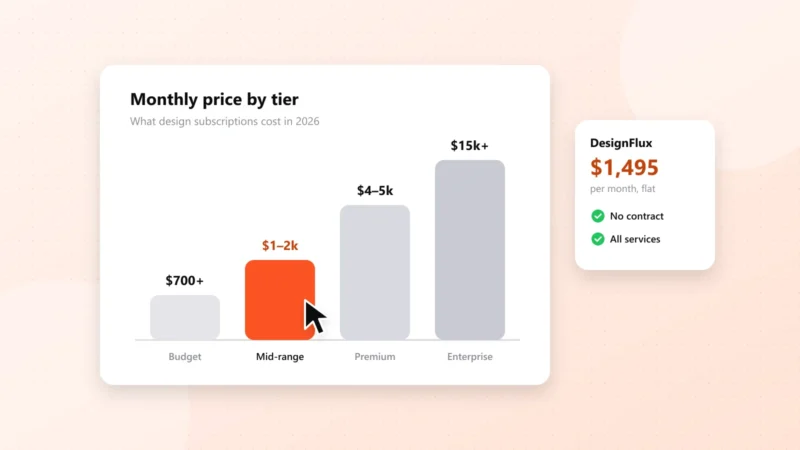
| Pricing | Per hour (about $25–$150) or per project | One flat monthly fee (about $700–$2,000 for many standard services) |
| Best for | One-off or specialist projects | Ongoing, varied design work |
| Turnaround | Depends on their other clients | Usually 1–2 days for straightforward requests |
| Revisions | Often capped or billed | Unlimited for covered work |
| Range of skills | One person’s skills | A team: branding, UI/UX, print and more |
| Availability | Holidays, sick days and busy periods affect you | Team coverage may be available |
| Management | You find, brief, chase and pay each person | One place to send requests |
| Commitment | Per project | Often monthly, cancel anytime |
These are typical differences, not universal rules. Individual freelancers and subscription providers may offer different turnaround times, services and commitments.
For example, some experienced freelancers provide ongoing retainers and structured project management.
Likewise, some design subscriptions offer dedicated designers, while others assign different team members depending on the project.
Before deciding, compare the actual deliverables and working arrangements rather than relying on general promises.
Cost: where the break-even point is
Freelancers look cheaper because you only pay for the hours you use. That’s true at low volumes. But as volume grows, hourly billing can overtake a flat fee quickly.
Take DesignFlux at $1,495 a month:
At $40 an hour, a freelancer costs the same after about 37 hours of work a month, roughly 9 hours a week.
At $75 an hour, it’s about 20 hours a month, or 5 hours a week.
Five hours a week is only a handful of social posts, an ad set and a one-pager. Some busy marketing teams can easily exceed that.
Freelancer rates and monthly costs
According to Upwork’s graphic designer cost guide, freelance graphic designer rates can range from approximately $15 to $150 per hour, depending on experience, specialization and project requirements.
For a practical comparison, here’s what different hourly rates mean at common monthly workloads.
| Monthly hours | $40/hour | $75/hour | $100/hour |
|---|---|---|---|
| 10 hours | $400 | $750 | $1,000 |
| 20 hours | $800 | $1,500 | $2,000 |
| 30 hours | $1,200 | $2,250 | $3,000 |
| 40 hours | $1,600 | $3,000 | $4,000 |
At $75 per hour, just 20 hours of freelance work costs approximately the same as a full month of DesignFlux.
However, this is a spending comparison, not a guarantee of equivalent output. A subscription processes requests according to its production capacity and project complexity.
An experienced freelancer may also complete certain tasks more efficiently than someone charging a lower hourly rate.
Therefore, evaluate both the cost and the quality of completed work.
The hidden costs of hiring freelancers
The rates also leave out some costs:
- Revision rounds that are billed or capped
- Platform fees if you hire through a marketplace
- Your time spent finding, briefing and following up
- Rush fees when you need something tomorrow
For example, spending three hours every week coordinating different freelancers adds roughly 12 hours of internal management time over four weeks.
That time has a cost, even if it doesn’t appear on a freelance invoice.
However, if you already work with a reliable designer who understands your brand, much of that coordination may disappear.
The financial advantage of a design subscription vs freelancer becomes clearer when your business needs frequent design production and the subscription can handle that workload efficiently.
Speed and availability
A good freelancer can be fast, but you share them with their other clients. When they’re busy, on holiday or ill, your work waits.
A subscription has a team behind it. At DesignFlux, most requests come back in 24–48 hours, and simple graphics often the same day. You’re less dependent on a single person’s calendar when team coverage is available.
For example, a marketing team preparing a weekend promotion may need several advertising variations before the campaign launches.
With a freelancer, you’ll need to confirm availability and agree on a delivery schedule.
With a subscription, you can place those tasks in your request queue and prioritize the most urgent designs.
However, remember that turnaround estimates usually apply to straightforward requests.
A detailed brand identity, complicated illustration or multi-page presentation may require additional production time.
The important question is whether the provider can reliably meet the deadlines associated with your typical projects.
Quality and consistency
Freelance quality can be excellent, but it varies from person to person, and finding a great freelancer takes trial and error. Every new freelancer has to learn your brand from scratch.
With a subscription that gives you a dedicated designer, the same person learns your brand once and gets better with every request. You stop re-explaining your colors, fonts and tone of voice.
For example, consider an ecommerce business running weekly product promotions.
Its designer needs to understand the brand’s typography, color palette, logo placement and preferred layout style.
A consistent designer can reuse those guidelines while creating fresh campaign visuals.
This saves time and reduces avoidable corrections.
However, long-term freelancers can provide the same continuity when you maintain an ongoing working relationship.
The difference is that a subscription may also provide access to other creative specialists when a project requires skills outside your dedicated designer’s expertise.
When comparing a design subscription vs freelancer, evaluate previous work, communication quality and how well each option can maintain your brand standards.
Management time
This is the cost most people underestimate. With freelancers, you’re the project manager: writing briefs, chasing updates, approving invoices and keeping track of files across different people.
A subscription moves much of that off your plate. At DesignFlux, a project manager helps organize requests and keeps the queue moving, while communication happens in one Slack channel.
For a small team, reducing administrative work can make a meaningful difference.
Instead of coordinating separate designers for social media graphics, promotional banners and presentation updates, you can manage requests through one workflow.
However, a subscription doesn’t eliminate your responsibilities entirely.
You still need to provide clear instructions, accurate assets, deadlines and consolidated feedback.
Adobe’s guide to creative request management explains why structured briefs and defined workflows help creative teams understand requirements and reduce unnecessary delays.
Whether you hire freelancers or subscribe to a design service, organized communication improves the process.
Risk
Freelancers are low-commitment. But if one disappears mid-project, you’re starting over, sometimes without the source files.
Subscriptions are monthly. The risk is paying for a month you don’t use. That’s why it’s worth choosing a service with a fair trial or refund policy and no long contract.
For example, a business might purchase a subscription expecting a busy month of marketing work.
If the campaign gets postponed, the company could still pay the subscription fee without using much production capacity.
Freelancers avoid that particular expense because you can hire them only when needed.
However, freelancer availability can become a problem when urgent work arrives unexpectedly.
You should also consider what happens if your designer becomes unavailable or a project requires significant revisions.
Before choosing either option, confirm ownership of completed designs, source file delivery and payment terms.
A reliable agreement protects your business regardless of the working model.
When a freelancer is the better choice
A freelancer is often the better option when:
- You need one logo, one website or one brochure and nothing for months
- You need a niche specialist: a particular illustration style, 3D, motion or packaging engineering
- You already have a great freelancer who’s reliable and available
For example, a newly established business may only need a logo and a basic brand identity package.
Paying a fixed project fee could make more financial sense than purchasing a recurring subscription.
Similarly, a company needing one highly specialized 3D illustration might benefit from hiring an expert with a portfolio in that exact field.
Freelancers can also be a good fit when you prefer a close working relationship with one individual.
The key is having a clear project scope, agreed pricing and realistic deadlines.
If your design needs remain occasional, paying only for the work you request is usually the simpler arrangement.
When a design subscription is the better choice
A subscription is often the better option when:
- You need design every week: social, ads, emails, decks and landing pages
- You’re tired of re-briefing and chasing different freelancers
- You want predictable costs your finance team can plan around
- You run several brands or clients (agencies get the most value; see white-label design)
For example, a marketing agency managing five client brands may regularly need social media graphics, advertising creatives and website visuals.
Hiring different freelancers for every type of asset can create additional coordination work.
A design subscription can provide a centralized production process where each request follows the relevant client’s brand guidelines.
Similarly, growing ecommerce businesses often need updated product banners, seasonal promotions and advertising variations.
When that demand continues every week, a fixed monthly design budget becomes easier to plan around.
The strongest case for a design subscription vs freelancer is a recurring workload that matches the provider’s available production capacity.
Can you use both?
Yes, and many teams do. A subscription handles the steady flow of everyday design, and a specialist freelancer handles the occasional niche project.
That way you get consistency for most of your work and specialist talent when you need it.
For example, a business might use a subscription for regular social media graphics, promotional banners and presentations.
Meanwhile, a specialist freelance illustrator could handle an occasional custom artwork project.
This arrangement allows the company to maintain consistent production without expecting one provider to handle every possible creative requirement.
However, keep your brand guidelines and project files organized so both parties work from the same approved materials.
Clearly defining responsibilities also prevents duplicated work and conflicting design decisions.
The bottom line
For one-off projects, a freelancer is usually the better buy. For ongoing design across marketing and sales, a design subscription can become cheaper past a few hours a week, while also simplifying project management.
However, your decision shouldn’t depend on cost alone.
When comparing a design subscription vs freelancer, consider how much design work you need, how frequently requests arrive and whether you prefer project-based flexibility or a consistent monthly workflow.
If your workload is occasional or highly specialized, a trusted freelancer may offer better value.
If you regularly produce social graphics, advertising creatives, sales materials and website assets, a subscription may be a more practical solution.
DesignFlux offers unlimited eligible design requests and revisions for $1,495 per month, with a dedicated designer, project manager and direct Slack communication.
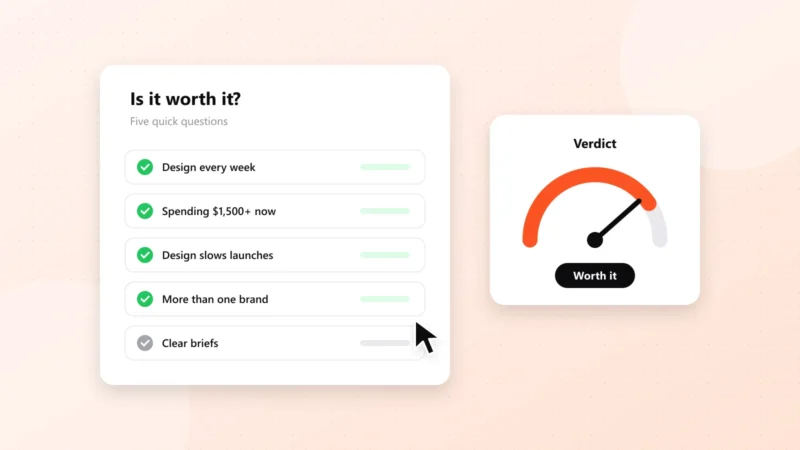
Want to check the numbers for your own workload? Read is a design subscription worth it?, compare what different subscriptions cost, or see DesignFlux pricing.