 DesignFlux Team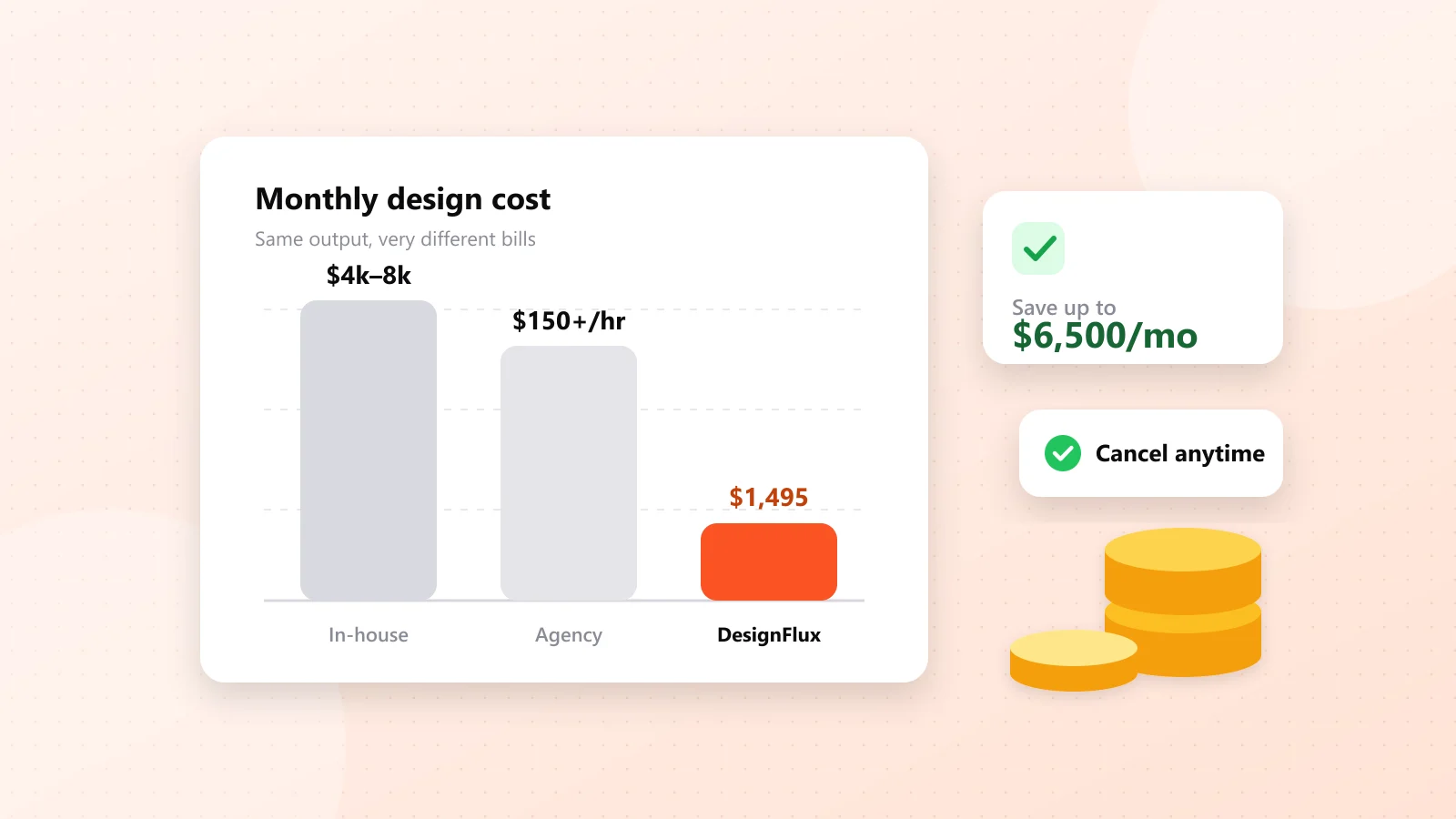
Every growing business reaches the same point: there’s more design work than anyone on the team has time for. Social posts pile up, the sales deck looks dated, and the new landing page is stuck waiting on visuals.
You have four options: hire someone in-house, retain an agency, juggle freelancers, or subscribe to a design service. Each one works for some teams. The trick is understanding what you’re actually paying for.
The real cost of an in-house designer
A good mid-level graphic designer typically costs $4,000–$8,000 a month in salary alone. Then come the costs that never appear in the job ad:
- Benefits and taxes, often adding 20–30% on top of salary
- Software and hardware: Adobe Creative Cloud, Figma, fonts, stock photos and a capable machine
- Recruiting time: writing the job post, reviewing portfolios, interviewing, onboarding
- Management overhead: someone has to brief, review and prioritize their work
- Single point of failure: vacations, sick days and the inevitable two-week notice
There’s also a skills problem. One designer rarely excels at everything. The person who builds a beautiful brand identity may not be the right person for conversion-focused landing pages or data-heavy infographics.
Agencies: great output, painful billing
Agencies bring a full team, but you pay for it. Rates of $150–$300 an hour are common, and every revision conversation shows up on the invoice. Projects are scoped up front, so anything outside the original brief becomes a change order.
Agencies make sense for big, one-off initiatives like a full rebrand. For the steady stream of everyday design work most businesses need, the economics rarely add up.
Freelancers: flexible, but hard to manage
Freelancers can be excellent and affordable. The challenge is consistency. When you work with several freelancers, you end up:
- Re-explaining your brand to each new person
- Chasing deadlines and waiting on replies
- Managing different file-sharing setups and invoices
- Losing previous versions when someone moves on
The money you save on rates often gets spent on your own time.
How a design subscription works
A design subscription replaces all of that with one flat monthly fee. With DesignFlux, for example, you pay $1,495 a month and get:
- Unlimited design requests and unlimited revisions
- A dedicated designer and a project manager
- Most requests delivered in 24–48 hours
- Access to a wider creative team for specialist work like UI/UX
- No contracts. Cancel anytime
You submit requests, prioritize them, and they get done one by one. No quotes, no hourly tracking, no hiring.
Side-by-side comparison
| In-house | Agency | Freelancers | Subscription | |
|---|---|---|---|---|
| Monthly cost | $4k–$8k + benefits | $150–$300/hr | Varies per project | Flat fee |
| Revisions | Limited by time | Billed | Often capped | Unlimited |
| Time to start | Weeks | Days | Days | Next day |
| Range of skills | One person | Broad | Varies | Full team |
| Commitment | Employment | Retainer | Per project | Cancel anytime |
When each option makes sense
Hire in-house when design is core to your product and you need someone embedded full-time in product decisions.
Use an agency for large, strategic one-off projects like a complete rebrand with research and naming.
Use freelancers for occasional, highly specialized work like illustration or 3D.
Choose a subscription when you have a steady flow of design needs (marketing, social, sales, web) and want speed, consistency and a predictable cost.
The bottom line
For most startups, marketing teams and agencies, the question isn’t “can we afford a designer?” It’s “can we afford to keep waiting on design?” A subscription gives you the output of a team at the price of a single, predictable bill.
Curious whether it fits your workload? See how DesignFlux works or check out the pricing.