 DesignFlux Team
Both a design retainer and a design subscription give you ongoing design help for a monthly fee. On the surface they sound almost identical. In practice, the design retainer vs design subscription decision works very differently, and choosing the wrong one can mean paying for hours you don’t use or waiting on work you need now.
When comparing a design retainer vs design subscription, the biggest difference is what you’re paying for. A retainer reserves a specific amount of professional time, while a subscription provides ongoing access to design production through a request-based workflow.
Neither model is automatically better for every business. The right choice depends on how often you need design work, the complexity of your projects and how much flexibility your team requires.
Here’s how the two models compare on cost, output, commitments and everyday usability.
The short version: design retainer vs design subscription
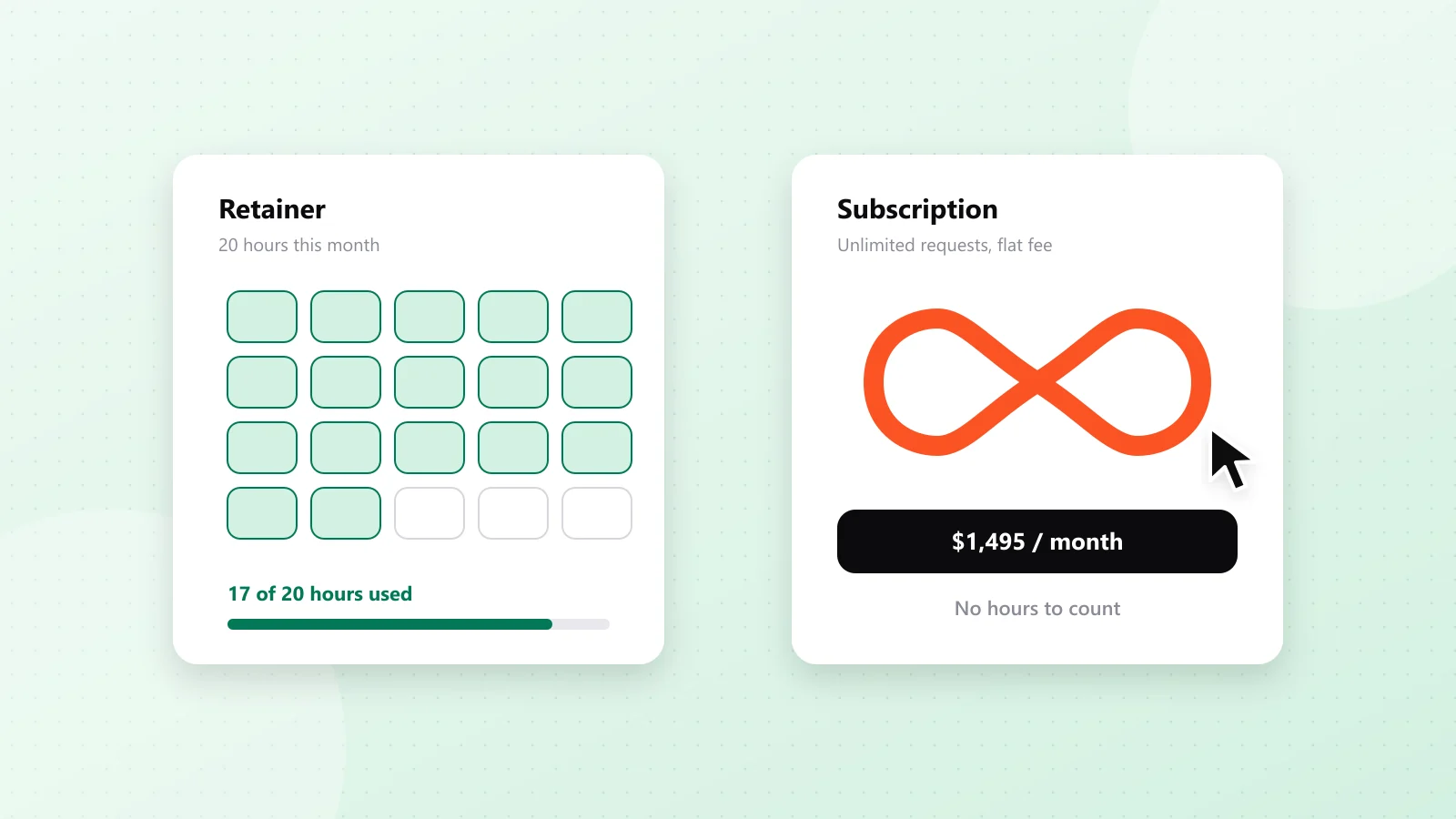
A design retainer reserves a fixed block of hours with an agency or freelancer each month, usually under a contract.
A design subscription gives you unlimited requests for a flat monthly fee. The team works through them in your order of priority, and you can usually cancel anytime.
For example, a business might pay an agency $3,000 per month for 20 hours of creative support.
Alternatively, that business could pay a fixed subscription fee to submit ongoing design requests without tracking individual hours.
However, unlimited requests don’t mean unlimited simultaneous production. Subscription providers typically complete work according to an active-request limit or a defined production schedule.
The key question is whether your business needs reserved professional hours or a consistent stream of completed design assets.
How a design retainer works
With a retainer, you agree in advance on a number of hours (say 20 or 40) and a rate. You pay the same amount every month, and the agency sets that time aside for you.
Typical features:
- Hourly rates: often $100–$300 an hour at agencies
- A scope of work: defines what’s covered
- Minimum terms: often 3–12 months
- Use-it-or-lose-it hours: sometimes with limited rollover
- Overages: billed at the hourly rate when you go over
Retainers are common for strategic, relationship-heavy work: brand strategy, campaign concepting or a long-term creative partnership.
For example, a company preparing for a product launch might retain an agency for creative direction, campaign planning, brand consultation and design execution.
Because the agency reserves time for the client, the company can schedule regular meetings and receive ongoing strategic input.
However, those meetings, revisions and project discussions may count toward the monthly allowance.
What does a design retainer cost?
Consider an agency charging $150 per hour for a 20-hour monthly retainer.
| Expense | Cost |
|---|---|
| Hourly rate | $150 |
| Reserved monthly hours | 20 |
| Monthly retainer | $3,000 |
| Annual retainer | $36,000 |
If the business uses only 12 hours during a particular month, the remaining eight hours may expire unless the contract allows rollover.
Conversely, if the team requires 25 hours, the additional five hours could cost another $750 at the same rate.
Some agencies offer different arrangements, including deliverable-based retainers or flexible monthly scopes. Therefore, don’t assume every retainer operates identically.
The AIGA resources on the business of design also highlight the importance of clear project scope, revisions, payment terms and intellectual property agreements.
Before signing, confirm exactly what your retainer covers.
How a design subscription works
With a subscription, you don’t buy hours. You buy access to a design team. You submit as many requests as you like, and they’re completed one at a time (or a few at a time, depending on the plan) with unlimited revisions.
Typical features:
- A flat monthly price: usually $700–$2,000 for many standard services
- Unlimited requests and revisions
- No individual scope documents or change orders for covered work
- Month-to-month terms: with cancel or pause options
- Fast turnaround: often 1–2 days for straightforward requests
At DesignFlux, for example, $1,495 a month gets you a dedicated designer and project manager in Slack, most designs in 24–48 hours, and no contract.
Instead of tracking billable hours, you organize requests in a queue and decide which tasks should receive priority.
For example, a marketing team might submit an Instagram carousel, a promotional banner, a sales presentation and a website graphic.
The designer works through those requests according to the subscription’s production capacity.
This model is useful when your design needs change throughout the month.
You can add new requests, revise existing designs and rearrange priorities without requesting a separate quote for every covered task.
However, complex projects still require more production time than simple graphics.
That means your actual monthly output depends on project complexity, revisions and the number of active requests your plan supports.
Side-by-side design retainer vs design subscription comparison
| Factor | Design retainer | Design subscription |
|---|---|---|
| What you buy | A fixed number of hours | Unlimited requests, worked through in order |
| Pricing | Hours × hourly rate | One flat monthly fee |
| Revisions | Count against your hours | Unlimited for covered work |
| Scope | Defined in a contract; extra work may be billed | Eligible design requests within the service scope |
| Commitment | Often 3–12 months | Usually month to month |
| Unused time | Often lost unless rollover applies | No hourly allowance to lose; unused queue capacity doesn’t roll over |
| Best for | Strategy and big creative campaigns | Steady, everyday design production |
These are common characteristics rather than universal rules. Individual providers may offer different billing arrangements, service limits and cancellation policies.
For example, some subscriptions include annual commitments, while some retainers allow unused hours to roll into the following month.
Therefore, always compare the actual service agreements before making a decision.
The big differences between a design retainer and design subscription
Although both models provide ongoing creative support, four differences have the biggest impact on your workflow and monthly budget.
1. Hours vs output
A retainer measures time. A subscription measures requests.
With a retainer, every revision, meeting and email may eat into your hours. With a subscription, eligible revisions are part of the deal, so you’re not rationing feedback against an hourly allowance.
For example, an agency might spend two hours discussing a campaign and another four hours preparing the first concept.
Those six hours reduce the time remaining in your retainer.
A subscription generally focuses on delivering the requested creative work instead of reporting every hour spent on it.
However, subscriptions don’t guarantee a specific number of completed designs each month.
The difference is how providers manage and charge for production, not whether one model has unlimited working capacity.
2. Flexibility
Retainers are planned in advance. If you need more one month, you pay overages, and if you need less, you often lose the hours.
Subscriptions flex naturally: busy months just mean a longer queue, and quiet months cost the same without wasted hours.
For example, an ecommerce business might need extra promotional graphics during Black Friday, followed by fewer requests in January.
A subscription makes it easier to submit additional work without negotiating new hourly estimates.
However, a longer queue can delay lower-priority projects during busy periods.
Also, remember that an active subscription still costs money during quiet months, even if you don’t submit requests.
3. Commitment
Retainers usually lock you in for months. Most subscriptions are month to month, so you can stop when you don’t need them.
Check the terms: some subscriptions advertise monthly prices that assume annual billing.
Also, review notice periods, cancellation procedures and refund conditions.
For example, a month-to-month subscription may offer more flexibility to a startup with changing design needs.
A longer retainer can make more sense when a company requires guaranteed access to strategic creative support throughout a major campaign.
Ultimately, the ideal commitment depends on how predictable your workload and budget are.
4. Admin
Retainers come with time reports, scope discussions and invoices to reconcile. Subscriptions generally have one recurring line item, the same every month.
With a retainer, your team may need to monitor remaining hours and approve additional spending when projects exceed the agreed scope.
A subscription typically replaces that process with a prioritized request queue.
However, both models still require clear briefs, feedback and internal approval.
According to Adobe’s guide to creative briefs, defining objectives, deliverables and expectations helps reduce misunderstandings and unnecessary revisions.
A better pricing model won’t solve an unclear design process. Good communication remains essential.
When a design retainer makes sense
A retainer is often the right choice when:
- You need senior strategic input: brand positioning, campaign ideas or creative direction
- You value a long-term agency relationship with account management and meetings
- Your work is large and project-based, like a full rebrand or a product launch campaign
For example, a growing company preparing to enter a new market might need extensive brand research, creative strategy and coordinated campaign development.
That work often involves workshops, stakeholder meetings and multiple rounds of strategic planning.
A retainer can provide reserved access to the people responsible for those decisions.
It may also be suitable when your company already has an internal design team but needs senior creative leadership.
In these situations, paying for dedicated expertise and availability can be more valuable than simply maximizing the number of completed graphics.
When a design subscription makes sense
A subscription is often the better fit when:
- You need a steady flow of production design: social posts, ads, decks, landing pages and print
- You want predictable costs without tracking hours
- You want to start fast (often the next day) without negotiating a scope
- You’re an agency that needs extra design capacity under your own brand (see white-label design for agencies)
For example, a marketing team producing weekly advertisements, social media posts and sales materials may benefit from having one consistent design workflow.
Instead of hiring different freelancers for every request, the team can submit briefs and manage priorities through a single provider.
Subscriptions can also help agencies handle increased client demand without immediately expanding their permanent staff.
When comparing a design retainer vs design subscription, recurring production volume is often the deciding factor.
If your team needs new creative assets every week, a subscription may provide a more convenient and economical arrangement.
Can you combine them?
Many companies do. They keep a strategic agency on a smaller retainer for big ideas, and use a design subscription for the everyday production that follows.
You get senior thinking where it counts and fast, affordable execution for everything else.
For example, an agency could develop a brand’s campaign strategy, messaging and creative direction.
Then, a design subscription could handle the recurring social posts, advertising variations, presentation graphics and promotional assets required to execute that strategy.
This approach separates strategic planning from high-volume creative production.
However, the two teams need clear communication and shared brand guidelines.
Otherwise, the production team may spend unnecessary time interpreting concepts or correcting inconsistent assets.
A hybrid arrangement works best when each provider has clearly defined responsibilities.
The real monthly cost comparison
A practical way to evaluate a design retainer vs design subscription is to compare the cost of a typical year.
Imagine a business that regularly needs social media graphics, advertising creatives, presentation updates and website visuals.
Consider these illustrative costs:
| Expense | Agency retainer | DesignFlux subscription |
|---|---|---|
| Monthly fee | $3,000 | $1,495 |
| Annual fee | $36,000 | $17,940 |
| Pricing structure | 20 hours per month at $150/hour | Unlimited eligible requests, processed in priority order |
| Revisions | Use allocated hours | Included |
| Additional work | May incur overage fees | Added to the queue, subject to service scope |
| Annual cost difference | $18,060 less |
In this example, the subscription costs $18,060 less annually.
However, that doesn’t mean both services provide identical expertise, capacity or deliverables.
The agency retainer offers 20 reserved hours each month, potentially including strategic consultation.
DesignFlux offers ongoing design production through a request-based workflow, rather than a guaranteed number of designer hours.
Therefore, the comparison is most useful when your primary requirement is recurring design production rather than strategic consulting.
Also, remember that savings only matter if the provider can deliver the quality and turnaround your business requires.
The bottom line
If you’re buying ideas and strategy, a retainer can be the right fit. If you’re buying design output, a subscription is often cheaper, faster and more flexible.
However, the right decision depends on your actual business needs.
When evaluating a design retainer vs design subscription, consider how frequently you request designs, whether you need strategic input and how much production capacity your team requires.
A retainer gives you reserved time and a structured agency relationship.
A subscription offers an ongoing design workflow with predictable pricing and the flexibility to submit new requests without purchasing additional hours.
For startups, marketing teams and agencies with regular graphic design needs, that flexibility can make a significant difference.
DesignFlux provides unlimited eligible design requests and revisions for $1,495 per month, with a dedicated designer, project manager and direct Slack communication.
Want to see how the numbers compare? Read how much a graphic design subscription costs, or see how DesignFlux works.