 DesignFlux Team
How much should I pay a graphic designer? For most US small businesses, freelance designers charge anywhere from $15 to $150 per hour, depending on their experience and the work involved. A simple social media graphic might cost $50 to $150, while a complete brand identity can run into thousands of dollars.
The right price depends on what you’re buying. A logo, product package, website layout and monthly collection of marketing graphics all require different skills and amounts of work.
You also have several ways to hire: hourly freelancers, fixed-price projects, in-house employees or monthly design subscriptions.
This guide breaks down realistic pricing, explains what drives costs and helps you choose the right option for your budget.
How much should I pay a graphic designer per hour?
According to Upwork’s graphic designer cost guide, freelancers on its platform charge between $15 and $150 per hour, with an average around $25. However, those figures include international freelancers, and experienced US-based designers often charge more.
Here’s a practical way to think about hourly pricing.
| Designer experience | Illustrative hourly rate | Best suited for |
|---|---|---|
| Entry-level | $15–$35 | Basic graphics, resizing, simple layouts |
| Intermediate | $35–$75 | Social campaigns, brochures, marketing materials |
| Experienced | $75–$100 | Brand identity, advanced layouts, creative direction |
| Specialist | $100–$150+ | Complex packaging, strategic branding, specialist design |
These are budgeting bands within the wider freelance market, not official national averages for each experience level.
For example, if a designer charges $50 per hour and spends eight hours creating a brochure, the design costs $400.
At $100 per hour, the same eight hours cost $800.
However, an experienced designer might finish the work faster, making the final difference smaller than the hourly rates suggest.
Don’t judge a designer by their hourly rate alone. Ask how many hours the project should require, what deliverables you’ll receive and how revisions affect the price.
How much should I pay a graphic designer per project?
Fixed project pricing often makes more sense for small businesses because you know the cost before work begins.
However, project quotes vary depending on complexity, number of concepts, revisions and final deliverables.
The following ranges are practical US freelance budgeting estimates, informed by published design pricing guides. They aren’t fixed industry rates.
| Design project | Estimated project cost |
|---|---|
| Simple logo | $150–$500 |
| Custom professional logo | $500–$2,000 |
| Complete brand identity kit | $1,500–$5,000+ |
| Single social media graphic | $50–$150 |
| Social media package, 10–20 graphics | $200–$800 |
| Flyer or poster | $100–$400 |
| Brochure or marketing collateral package | $300–$1,200 |
| Product packaging design | $500–$3,000+ |
| Landing page UI design | $500–$2,000 |
| Small business website design | $1,500–$5,000+ |
These estimates generally cover design services, not printing, website development, hosting, photography or other production expenses unless specifically included.
Logo design: $150–$2,000+
A basic logo from a newer freelancer may cost a few hundred dollars. More experienced designers charge more for original concepts, refinement, typography and testing.
For a serious small business, budget roughly $500–$2,000 for a professionally developed logo with appropriate files and usage rights.
Ask whether the quote includes vector files, black-and-white variations, a transparent background and revisions.
Brand identity kits: $1,500–$5,000+
A brand kit goes beyond the logo.
It may include a complete logo suite, color palette, typography system, business cards, social media templates and brand guidelines.
Expect the price to increase when the project also involves audience research, brand positioning, messaging or extensive rollout support.
A business launching several products may benefit more from a consistent identity system than from purchasing a standalone logo.
Social media and marketing graphics: $50–$1,200
Simple social graphics usually cost less than complicated advertising layouts or multi-slide carousels.
A single promotional post might cost $50–$150, while a package of reusable templates could cost several hundred dollars.
Brochures, presentations and marketing collateral generally require more layout planning, especially when they contain substantial copy or data.
If your business publishes frequently, buying individual designs can become expensive.
Packaging and website design: $500–$5,000+
Packaging requires more than an attractive front panel. Designers may need to consider dielines, materials, legal information, print specifications and multiple product variations.
Likewise, website design depends on page count, complexity and functionality.
A landing page design is different from a complete ecommerce website.
Always confirm whether your website quote includes only the visual interface or also development, responsive implementation and testing.
What affects graphic designer pricing?
Two designers can quote completely different prices for the same brief. Usually, the difference comes down to five factors.
1. Experience and portfolio
Experienced designers charge more because they’ve handled more projects, developed stronger processes and learned to solve complex design problems.
However, years of experience alone don’t guarantee quality.
Review work relevant to your industry, not just attractive portfolio images.
2. Specialty
A designer who produces everyday social graphics may charge less than someone specializing in packaging, advanced UI/UX or custom illustration.
Specialized projects require different technical knowledge and production processes.
For example, designing a product label for professional printing involves requirements that don’t apply to an Instagram graphic.
3. Project complexity
A single promotional banner and a complete advertising campaign aren’t equivalent projects.
More concepts, pages, design variations, stakeholders and revisions increase the workload.
To avoid unexpected charges, define the scope before work begins.
4. Timeline
Urgent projects can cost more because the designer must rearrange existing commitments or work outside normal hours.
If possible, plan marketing materials in advance.
Also, distinguish between the deadline for the first draft and the deadline for final approved files.
5. Usage rights and ownership
Commercial usage rights, source files and exclusive ownership can affect pricing.
Before paying, confirm whether you can use the final designs in advertisements, packaging, merchandise and other commercial applications.
For logos especially, discuss originality, third-party assets and ownership.
Don’t assume paying the invoice automatically transfers every intellectual property right.
How much does an in-house graphic designer cost?
Hiring a full-time designer introduces a different cost structure.
According to the US Bureau of Labor Statistics, the median annual wage for graphic designers was $62,960 in May 2025, approximately $5,247 per month.
That figure covers wages, not the full cost of employing someone.
You must also consider employer payroll taxes, benefits, paid leave, equipment and software.
For budgeting purposes, adding roughly 25–30% for benefits and employer-related costs gives this illustration:
| Expense | Estimated annual cost |
|---|---|
| Median graphic designer salary | $62,960 |
| Additional costs at 25% | $15,740 |
| Total at 25% | $78,700 |
| Total at 30% | $81,848 |
This produces an estimated monthly compensation expense of approximately $6,558–$6,821 before separately purchased equipment, recruiting or software.
Actual employer costs vary considerably by location and benefits package.
An employee can provide dedicated working hours, join internal meetings and collaborate closely with your team.
That makes hiring attractive when design is a daily operational requirement.
However, one designer may not have every specialty your business needs.
When does a flat-rate design subscription make sense?
If you only need a logo or occasional flyer, paying per project is usually more economical.
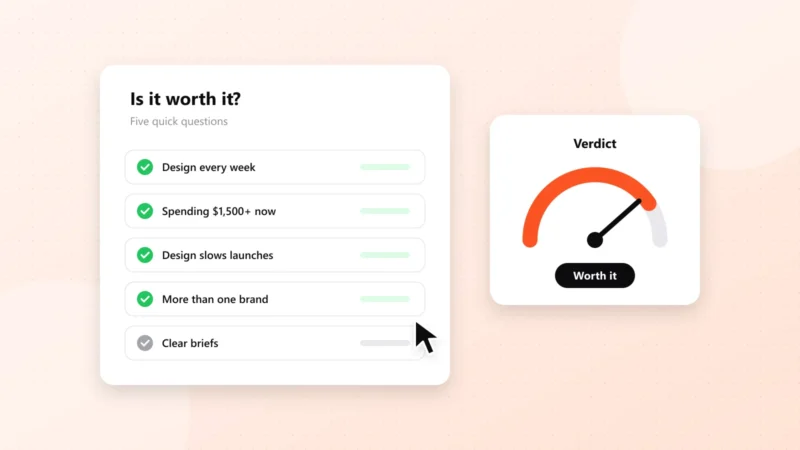
However, businesses producing social media graphics, advertising creatives, presentations and website assets every week face a different calculation.
Consider a freelancer charging $75 per hour.
| Monthly freelance hours | Monthly cost |
|---|---|
| 5 hours | $375 |
| 10 hours | $750 |
| 20 hours | $1,500 |
| 30 hours | $2,250 |
| 40 hours | $3,000 |
At approximately 20 freelance hours per month, spending reaches $1,500.
DesignFlux offers an unlimited graphic design subscription for $1,495 per month, including a dedicated designer, project manager, unlimited requests and revisions, typical 24–48 hour turnaround and no contracts.
The important distinction is that unlimited requests don’t mean unlimited simultaneous work. Designs move through a production queue, so your actual output depends on complexity and turnaround.
This comparison shows where monthly spending may break even, not that a subscription guarantees 20 equivalent hours of work.
For businesses with a consistent flow of everyday design requests, predictable monthly pricing may simplify budgeting and coordination.
How to avoid overpaying for graphic design
Before hiring, prepare a clear brief describing the project goal, audience, deliverables, exact copy, dimensions and deadline.
Then request an itemized quote.
Ask what the price includes, how many revision rounds you’ll receive and whether the designer will provide editable files.
Compare portfolios and deliverables rather than simply choosing the lowest bidder.
For larger projects, agree on milestones and payment terms in writing.
Finally, consider your actual workload over three months. If you repeatedly order similar graphics, templates or a subscription may make better financial sense than individual projects.
Frequently asked questions
Is $50 an hour too much for a graphic designer?
No, $50 per hour is a reasonable freelance rate for many professional graphic design projects, particularly when the designer has relevant experience and produces reliable work. What matters is the estimated project time, quality of deliverables and whether the price includes necessary revisions and files.
How much should a small business spend on graphic design?
A small business should base its design budget on the number and complexity of assets it actually needs, rather than a fixed percentage of revenue. Occasional projects may cost a few hundred dollars, while consistent monthly marketing production can justify a recurring budget of $1,000 or more.
Is it cheaper to hire a freelancer or a design subscription?
A freelancer is generally cheaper when you need occasional designs, while a subscription can become more economical when requests arrive regularly throughout the month. Compare your actual freelance spending with the subscription fee, then check the provider’s production limits and typical turnaround before deciding.
How much should I pay for a professional logo?
For a custom professional logo, a practical small-business budget is approximately $500–$2,000, although simpler projects may cost less and extensive branding work can cost much more. Check whether the quote covers original concepts, revisions, scalable vector files, logo variations and appropriate commercial rights.
Should I pay a graphic designer hourly or per project?
Choose hourly pricing when the scope is uncertain or you’ll need ongoing small adjustments, and fixed project pricing when you can clearly define the deliverables. Whichever model you choose, agree on the review process, estimated cost, ownership rights and how additional work will be charged.
The bottom line
So, how much should I pay a graphic designer? Pay according to the complexity, skill level, deliverables and frequency of the work.
For occasional projects, compare fixed-price freelance quotes. For specialized work, prioritize relevant expertise. For ongoing daily design needs, consider an employee or a subscription.
The best deal isn’t necessarily the lowest hourly rate. It’s the arrangement that consistently delivers the design quality your business needs at a cost you can sustain.