 DesignFlux Team
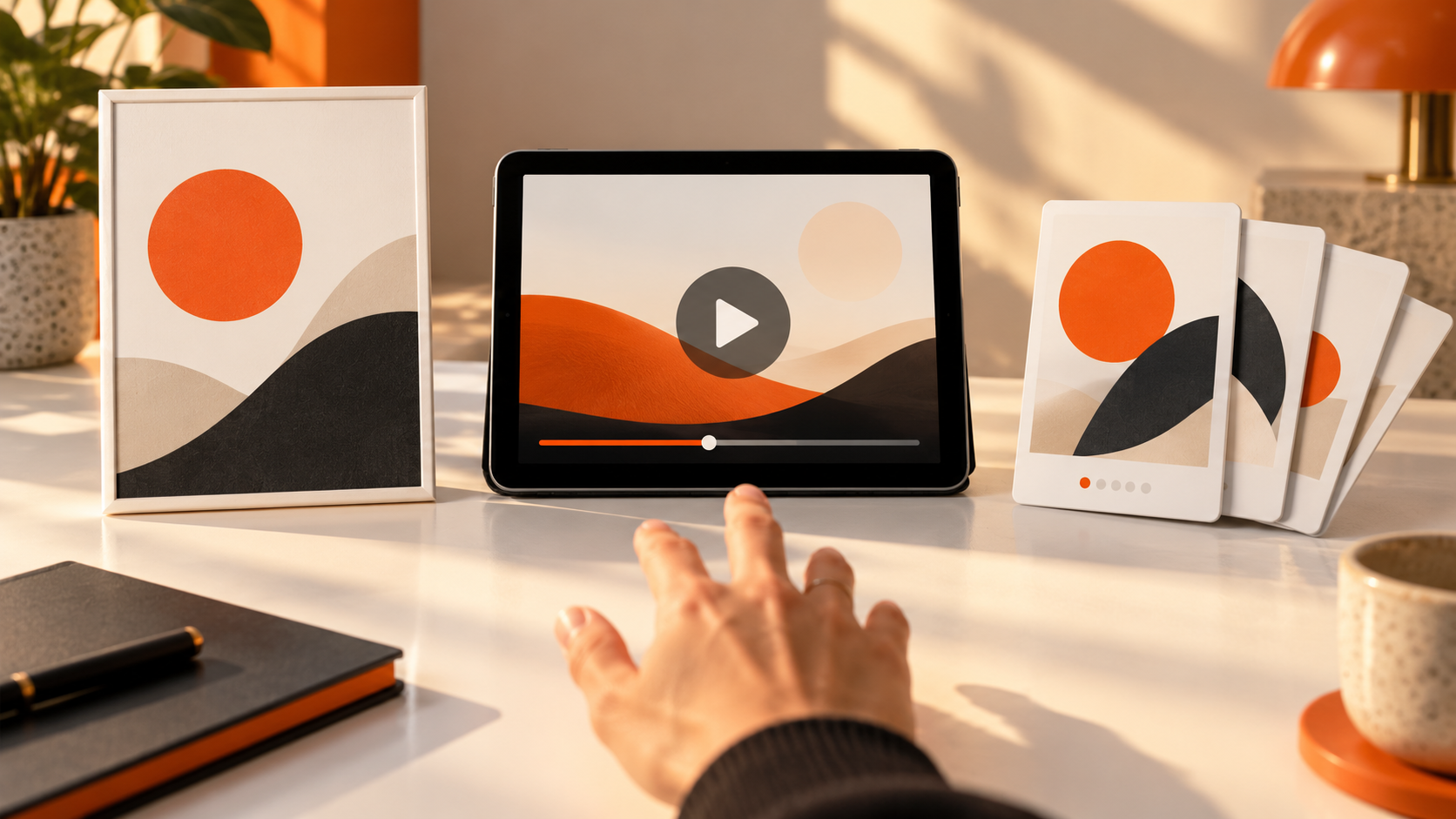
Choosing between static vs video vs carousel ads is not about finding one format that always performs best. It is about matching the creative format to the product, the offer, the campaign objective, and the amount of information your audience needs before taking action.
If you run a Meta advertising agency, you already know that a strong concept can get lost in the wrong execution. A product that needs a demonstration may struggle with a single image, while a straightforward promotion might not need video production at all.
Each format has a job. Static images communicate one message quickly. Video adds motion, sound, and storytelling. Carousels give you multiple cards to explain different products, benefits, or steps.
Here is how to choose between them, plan production sensibly, and build a creative mix that supports your campaign without wasting time or budget.
Static vs Video vs Carousel Ads: What Each Format Does Best
Before selecting a format, define what the advertisement needs to communicate. Are you promoting one clear offer, demonstrating how a product works, or presenting several products together?
Your answer helps determine which format deserves priority.
1. Static Image Ads: One Image, One Clear Message
Static ads use a single image to communicate a product, benefit, offer, or idea. They are particularly useful when the message can be understood without movement or a sequence of scenes.
Where static ads work well
- Single offers: Highlight a promotion, product, or specific benefit without competing messages.
- Concept testing: Explore different headlines, visual directions, offers, and product presentations without producing a video for every idea.
- Product-focused campaigns: Give a product image, price, or key selling point a clear place in the composition.
- Fast creative production: Produce and revise assets without coordinating filming, editing, voiceovers, or motion graphics.
For example, an ecommerce advertiser could test whether a product benefit, a seasonal offer, or a lifestyle image communicates the strongest reason to shop. Each static creative can explore a distinct idea while keeping the rest of the campaign setup as consistent as practical.
However, static images have limitations. They cannot demonstrate a product through movement, deliver a spoken explanation, or build a detailed story across time. If understanding the product requires seeing several actions, another format may communicate the idea more naturally.
How to design a strong static ad
Start with one message, then establish a clear visual hierarchy. Use a relevant image, a readable headline, an accurate offer, and a visible next step. Avoid filling the composition with every possible product benefit.
Our static ad design guide explains the core principles behind effective layouts, from visual hierarchy to mobile readability.
For most agencies, static ads are a sensible starting point when the goal is to compare creative concepts efficiently. Nevertheless, a simple format still needs a strong idea. A clean layout cannot rescue an unclear offer.
2. Video Ads: Demonstration, Motion, and Storytelling
Video ads introduce movement and, where appropriate, sound. They allow you to show how a product works, demonstrate a transformation, explain a process, or tell a story that would be difficult to communicate in one image.
Where video ads work well
- Product demonstrations: Show the product in use instead of relying entirely on a static product photograph.
- Multi-step explanations: Walk through a process when the order of actions matters.
- Storytelling: Build context around a product, service, or customer problem.
- Visual proof: Demonstrate a feature or experience that benefits from movement.
Consider a hypothetical advertiser selling a kitchen appliance. A static image can communicate its appearance and a key benefit. A video can show how the appliance operates, what the process looks like, and how someone might use it at home.
That extra context can be useful when shoppers need more information before considering a purchase. However, video does not automatically communicate better than a static image. The product, concept, execution, and audience all matter.
Video’s production trade-offs
Video often requires more coordination. Depending on the concept, you may need footage, product demonstrations, editing, captions, voiceovers, motion graphics, or several aspect-ratio versions.
Consequently, producing many video variations can take more time and resources than producing static alternatives. This matters when an agency needs to explore several creative directions before committing to a larger production effort.
The opening moments also matter. Give viewers a clear reason to keep watching rather than spending too long on an introduction, logo animation, or generic establishing shot.
Finally, make the video understandable without assuming everyone will hear the sound. Clear visuals, readable captions where appropriate, and a logical sequence help communicate the message in different viewing situations.
3. Carousel Ads: Multiple Cards, Multiple Messages
Carousel ads present multiple cards within one advertisement. Each card can feature a different product, benefit, image, or stage of a sequence.
This structure is useful when a single image would force you to squeeze too much information into one composition.
Where carousel ads work well
- Product ranges: Give different products or variations their own cards.
- Bundles and collections: Present related items in a structured sequence.
- Multiple benefits: Explain distinct advantages without crowding one image.
- Step-by-step stories: Show a process or sequence in which each card adds context.
For example, a hypothetical furniture retailer could use separate cards to introduce a desk, chair, shelving unit, and matching accessories. Alternatively, a software advertiser might use the cards to explain several features of one product.
Each card can communicate a different point, but the complete carousel should still feel like one coherent advertisement.
The limitations of carousel ads
A carousel needs several strong images or visual concepts. If only the first card is compelling, the remaining cards may add little value. In addition, some viewers may never swipe beyond the opening card.
That makes the first card especially important. It should establish the product or central message and give viewers a reason to explore further.
Card order also matters. Put the most important information early, then arrange the remaining cards in a logical sequence. Avoid treating the carousel as a collection of unrelated graphics simply because the format allows multiple images.
Static vs Video vs Carousel Ads: Compare the Decision Factors
The best choice depends on what you need the creative to accomplish. Instead of choosing a format because it is popular or familiar, evaluate the practical requirements of the campaign.
| Decision factor | Static image | Video | Carousel |
|---|---|---|---|
| Single clear offer | Strong fit | Useful when motion adds context | Useful if several details need separate cards |
| Product demonstration | Limited to a single visual | Strong fit | Can show steps across cards |
| Multiple products | Can work with a simple group image | Can present a collection in motion | Each product can have its own card |
| Production speed | Often faster to create and revise | Usually requires more production work | Requires multiple coordinated cards |
| Creative testing | Useful for exploring distinct concepts quickly | Tests motion, demonstration, and story | Tests card sequences and product presentations |
| Information depth | Best when the message is concise | Can explain through movement and narration | Can distribute information across cards |
This comparison is a planning guide, not a performance ranking. Any format can produce a useful creative, and any format can fall short if the underlying message does not match the audience’s needs.
Consider what you are selling
If the offer is simple and immediately understandable, start by considering a static image. For example, a product promotion with one clear benefit may not need motion or several cards.
However, if the audience needs to see how a product operates, video may explain the value more naturally. Meanwhile, a business with a varied catalog or several related benefits may have a good reason to use a carousel.
Consider production time and available assets
Think about the material your client already has. High-quality product photographs may support several static concepts or a carousel. Useful demonstration footage may make video production more practical.
If you need to create all the assets from scratch, consider the extra coordination involved before committing to a format. The right decision balances communication needs with realistic production capacity.
Consider what you want to learn
Testing goals should influence format selection. If you are still exploring the central message, static creatives can help you compare different concepts before investing in more complex production.
Once you identify a concept worth developing, video can explore how motion or demonstration changes its presentation. A carousel can examine how multiple products or benefits work together within one ad.
Keep in mind that changing format also changes how people experience the message. When you compare results, account for those differences rather than assuming the format alone explains the outcome.
A Practical Guide to Choosing the Right Ad Format
Use the following decision process when planning your next campaign.
Start with static when the idea is still unproven
Build a small set of genuinely different concepts. You might test a product-focused visual, a benefit-led headline, and a different offer presentation, depending on the campaign objective.
Keep the test organized so you can understand what changed. If every creative changes the offer, headline, visual, and format simultaneously, you will have a harder time identifying what influenced the results.
Add video when movement improves the explanation
Once you have a concept worth developing, ask whether motion will add meaningful information. A demonstration, product walkthrough, or visual sequence may justify video production.
However, do not create video simply because the campaign needs something new. If movement does not improve the message, a well-executed static ad may be the more practical choice.
Choose carousel when separate cards add real value
Use carousel when multiple products, features, or steps deserve individual attention. Give every card a clear purpose, while keeping the full sequence connected to one campaign idea.
Before delivery, check that the opening card works on its own and that the remaining cards contribute useful information. If the concept works just as well in one image, the extra production may not be necessary.
Why Mixing Ad Formats Can Make Sense
Static, video, and carousel ads do not have to compete for the same role. A campaign can use each format for a different communication task.
For example, static creatives might introduce several product benefits, video could demonstrate the most important feature, and carousel could present a wider product range.
That approach gives the campaign variety without forcing every message into the same format. Nevertheless, each asset should serve a clear purpose, and the campaign still needs consistent messaging between the advertisement and its destination.
When planning Meta ads, also consider the intended placement and the assets available for each format. Adapt the composition to the placement instead of simply resizing one creative and assuming it will work everywhere.
Common Mistakes When Choosing Between Static, Video, and Carousel Ads
- Forcing one format everywhere: A single image, video, or carousel is not automatically right for every offer.
- Producing video too early: A complex production may be unnecessary when a static concept could answer the initial creative question.
- Weak carousel openings: The first card fails to communicate the main message or give viewers a reason to continue.
- Overloading static designs: Too much text and too many benefits undermine the format’s simplicity.
- Ignoring production constraints: The team commits to more versions than it can deliver and review properly.
- Confusing format with strategy: A new format cannot fix an unclear offer or a message that does not address the audience.
The solution is to start with the campaign objective, select the format that communicates it clearly, and make production decisions based on what you need to learn.
Building a Reliable Creative Production Workflow
For agencies, format selection is only part of the challenge. You also need a process that delivers consistent creative without slowing down campaign launches.
Begin with a clear brief that identifies the offer, audience, message, format, required sizes, and delivery date. Then organize the concepts, review the creative, and prepare the correct files for the intended placements.
As the client workload grows, an external production partner can help your team maintain capacity without immediately hiring another full-time employee.
DesignFlux offers an unlimited graphic design subscription for $1,495 per month, with a dedicated designer and project manager, unlimited requests and revisions, typical 24 to 48 hour turnaround, and no contracts. It supports static and carousel production for agencies and advertisers that need a consistent design workflow.
Choose a production model that fits your volume and review requirements. A subscription, freelancer, or in-house designer can each make sense depending on the work, your budget, and how closely you need to manage the process.
Frequently Asked Questions
Are static ads better than video ads?
Not universally. Static ads suit concise messages and quick concept exploration, while video can help demonstrate a product or explain a process. The better choice depends on the offer, audience, available assets, and campaign objective. Evaluate each format against the job it needs to perform rather than assuming one always wins.
When should I use carousel ads instead of static images?
Use carousel when several products, benefits, or steps deserve separate cards. A static image is often simpler when one visual and one message can communicate the offer clearly. However, a carousel needs a strong opening card and a useful sequence, so avoid adding cards that do not contribute to the message.
Should I test static ads before producing video?
That can be a sensible approach when you need to compare concepts and the idea does not depend on motion. Static assets can help you explore different messages before committing to video production. However, if demonstration or movement is central to the concept, testing the idea in video may be appropriate from the start.
Can I use static, video, and carousel ads in the same campaign?
Yes, when each format serves a clear purpose. You might use static images for concise offers, video for product demonstrations, and carousel for product ranges or sequences. Keep the campaign message consistent, then review each asset in context instead of assuming all formats should communicate in exactly the same way.
What should I consider before choosing an ad format?
Start with the campaign objective, the complexity of the offer, and how much explanation the product needs. Then consider available assets, production time, testing goals, and placement requirements. Finally, choose the simplest format that communicates the message clearly, unless motion or multiple cards add meaningful value.